Related pages
Building resilience through problem solving
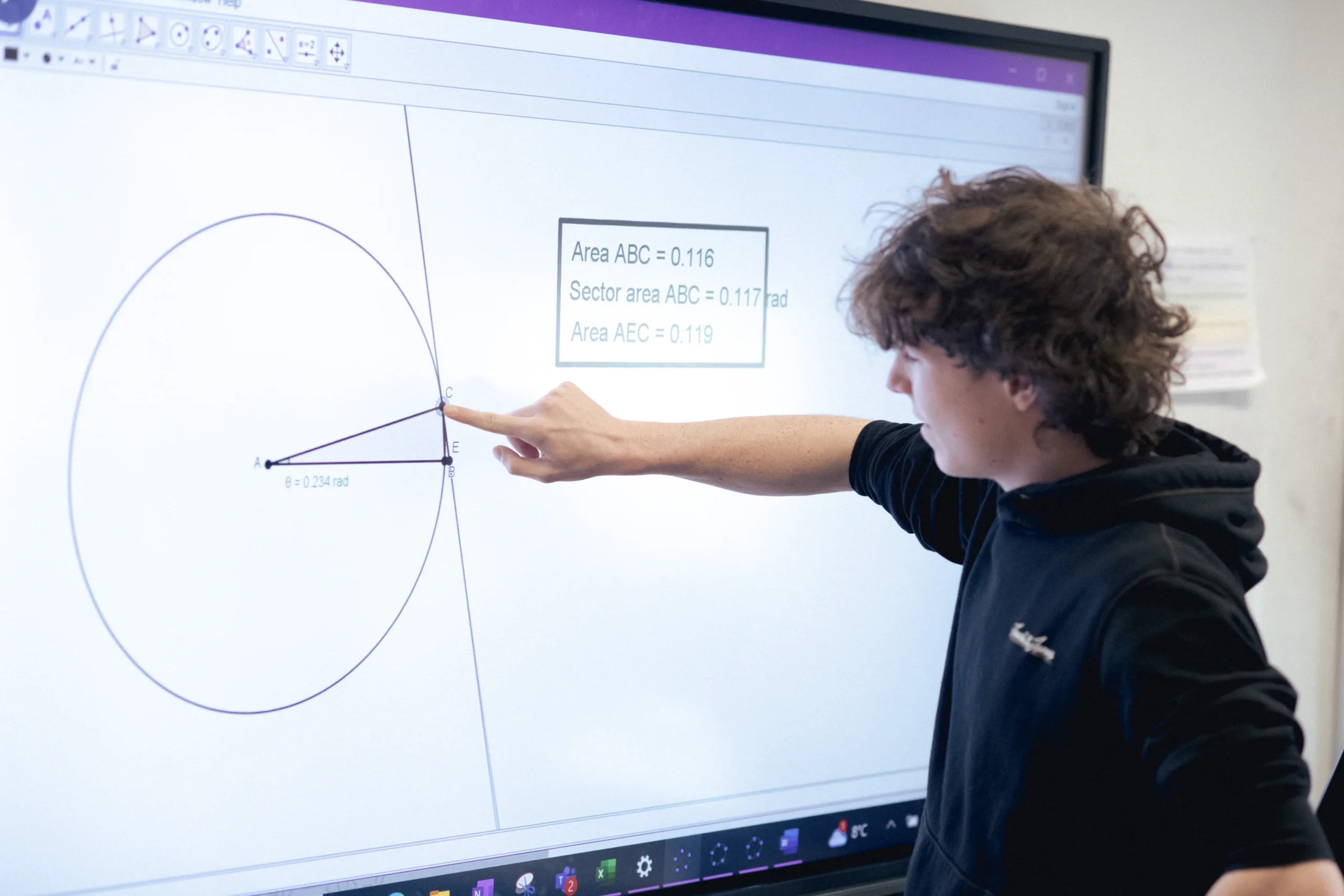
At Exeter Maths School we believe in preparing students to be adaptive and able to tackle challenges confidently, and so problem solving is embedded in all our lessons. We encourage a collaborative approach to tackling problems with plenty of discussion and sharing ideas. Although there will be times when students need silent concentration, they gain far more from working together and learning from one another than they would do working in isolation.
We also offer optional problem solving classes for Maths, Physics and Computer Science. Initially these are used to develop problem solving skills and techniques, and broadening students’ skills. Later in the course, they focus on supporting students as they prepare for university entrance exams such as STEP, MAT and PAT, as well as preparing for competitions such as BMO and BIO.
Problem solving by subject
Mathematics Problem Solving Classes
Mathematics problem solving starts at Autumn half term in year 12, looking at specific techniques such as enumeration methods, and the pigeonhole principle, and how these can be applied to solve problems. We then use UKMT and STEP questions as a focus to share approaches and techniques. We will also address skills such as getting to grips with undergraduate texts. In addition to being great fun, the year 12 course lays excellent foundations for the focused preparation needed for university admission tests.
In year 13 we hit the ground running preparing for the MAT and TMUA assessments in October. We have sessions looking at commonly used skills such as comparing logarithms and graph sketching.
We then move on to using preparation for the STEP II and STEP III exams as a focus. Teachers demonstrate techniques, skills and ways of thinking, before giving students a chance to tackle these challenging questions in a supportive environment. The majority of sessions are themed around a topic, for example hyperbolic trigonometry, though some are themed around a problem solving method.
Despite the focus on university entrance tests in year 13, we always have students who will choose take the course even though they are not doing these assessments – maths is fun, especially when it’s challenging!
Computer Science Problem Solving Classes
The computer science problem solving course runs for a year, starting just after the February half term on year 12 and finishing at the same point in year 13. In the first half of the course, lessons demonstrate a useful algorithm, or programming technique, and then give scaffolding and support to enable students to apply it in a program. Last year we considered:
- Maze generation with Prims algorithm.
- Pathfinding Algorithms
- Floodfill Algorithms
- Matching Algorithms
- Simplex algorithm
- Genetic Algorithms
- Image Stacking
In Year 13 we will explore algorithmic problem solving techniques such as:
- Dynamic programming
- Backtracking
- Divide and conquer
Students can then use these to create their own efficient algorithms or to tackle “algorithmic problem solving” questions. In particular, in the first term we apply these skills to the computer science questions in the MAT entrance tests (if students are intending to take the MAT for computer science then it is recommended that they also attend Maths problem solving classes). In later sessions we shift focus to preparing for the BIO competition.
Physics Problem Solving Classes
Physics Problem Solving starts at the beginning of the Spring Term in Year 12.
We first look at Fermi questions, analysing how to identify the physics to apply, when it is appropriate to approximate and how to obtain quick order-of-magnitude estimates. From there we move on to applying calculus in physics. Calculus is at the heart of much of the models used in physics, but methods of application can feel different to those used in maths. We will consider a lot of examples of using rates of change and integrals to solve more complex physics problems.
Towards the end of the year, and into the start of Year 13, we focus on applying our techniques to high level questions with a view to preparing students for entrance exams like PAT and for entering the BPhO.
Problem Solving Throughout the Curriculum
Whilst we think our problem solving classes are great, and the feedback from students is positive too, we know that becoming an accomplished problem-solver needs a lot of time, exposure to interesting problems and practice than these lessons can provide alone. That’s why thinking, exploring and grappling with challenges is embedded in our whole currriculum: the Exeter Mathematics Certificate provides students with the opportunity to solve substantial problems over weeks or months; Curriculum-X explores challenges beyond the normal 6th form curriculum; the Tutorial Programme fosters critical thinking and academic debate; core A-level teaching requires students to explore, think and discuss ideas day in, day out. It’s worth reviewing our full curriculum to best understand how the classes above relate to the overall experience of studying at EMS.