I bleep, therefore I bloop
Computer Science involves questions that have the potential to change how we view and connect with the world; for example, we may be computing with DNA at some stage in the future, with computer circuits made of genes. This leads to the question, does the natural world ‘compute’?
Learning through experiment
Experimental Computer Science can be done with computers whereby we can learn more about the natural world by observing the behaviour of interacting software simulations.
Beyond the screen
Computing is about designing new sets of instructions (algorithms) to solve new problems. In this sense Computing is no more about computers than astronomy is about telescopes.
Close at hand
Many great questions lie in the future for Computer Scientists to solve and this course, with its emphasis on abstract thinking, general problem solving, mathematical reasoning, scientific and engineering-based thinking, is a good foundation for understanding these future challenges.
Specialist equipment
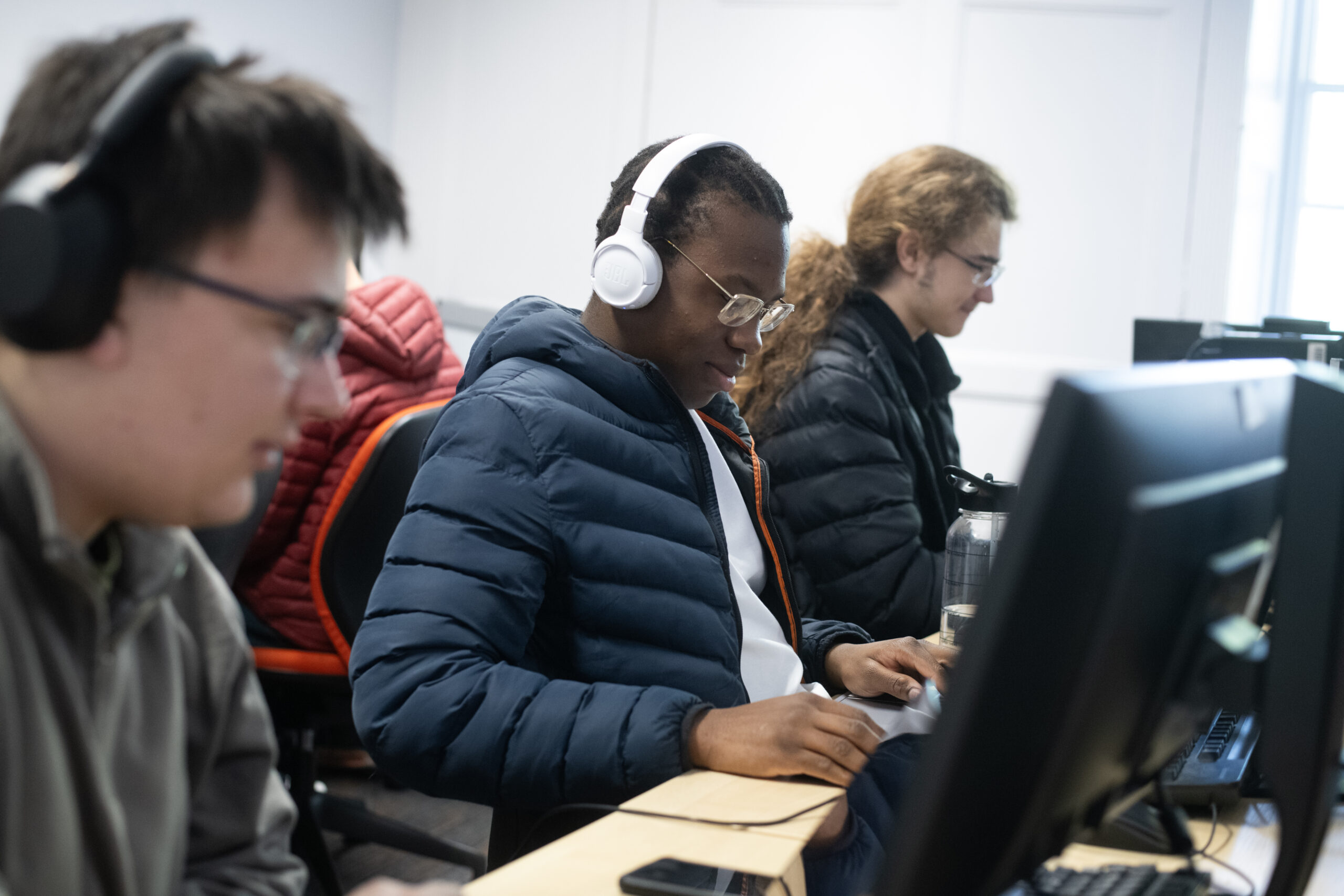
Computer Science is taught in a specialist computer room. The course is focused on programming and its applications. There are opportunities for students to use Raspberry Pis, Arduinos and other microcontrollers.
Learn the languages of the machines
Initially, students will study Python 2.7 but opportunities to work with Java, C and other languages are also integral to the course.
Related pages
Computer Science overview
Topics covered on the course include programming, data structures, algorithms, data representation, computer systems, computer organisation and architecture, communication and networking, databases, functional programming, the theory of computation, consequences of uses of computing and big data.
Qualifications
Examination board
A-level Computer Science
AQA
Assessment
40% on-screen examination, 40% written paper and 20% practical project.
Units of Study for Year 12
Students will begin working towards the completion of each module but will not sit any external examinations until year 13.
Units of Study for Year 13
Paper 1 and Paper 2 for A-level and coursework.
Other Activities
Students will apply their knowledge to practical applications and will be encouraged to enter challenges and competitions such as the British Informatics Olympiad, Project Euler, the National Cipher Challenge and those run by the Computer Science Students’ Network. You can read more about our Computer Science problem solving classes on the problem solving page.
For further details about our Computer Science curriculum, contact Mel: melaniedenning@exeterms.ac.uk