Bright minds turn curiosity into discovery
Studying Physics is the process of equipping yourself with the tools not only to explain and understand the world around you, but to go wherever your imagination leads.
Considering the possibilities
Perhaps you’ll design new solar panels, make a leap in medical physics or finally unify our understanding of the four forces.
Social impact
Physics is not only important in its own right but is also an essential component of other Natural Sciences, Engineering and Technology.
Applied mathematics
Furthermore, it is a subject in which mathematical principles, effectively applied, are used to develop understanding and underpin progress.
Related pages
Explore, Experiment, Excel
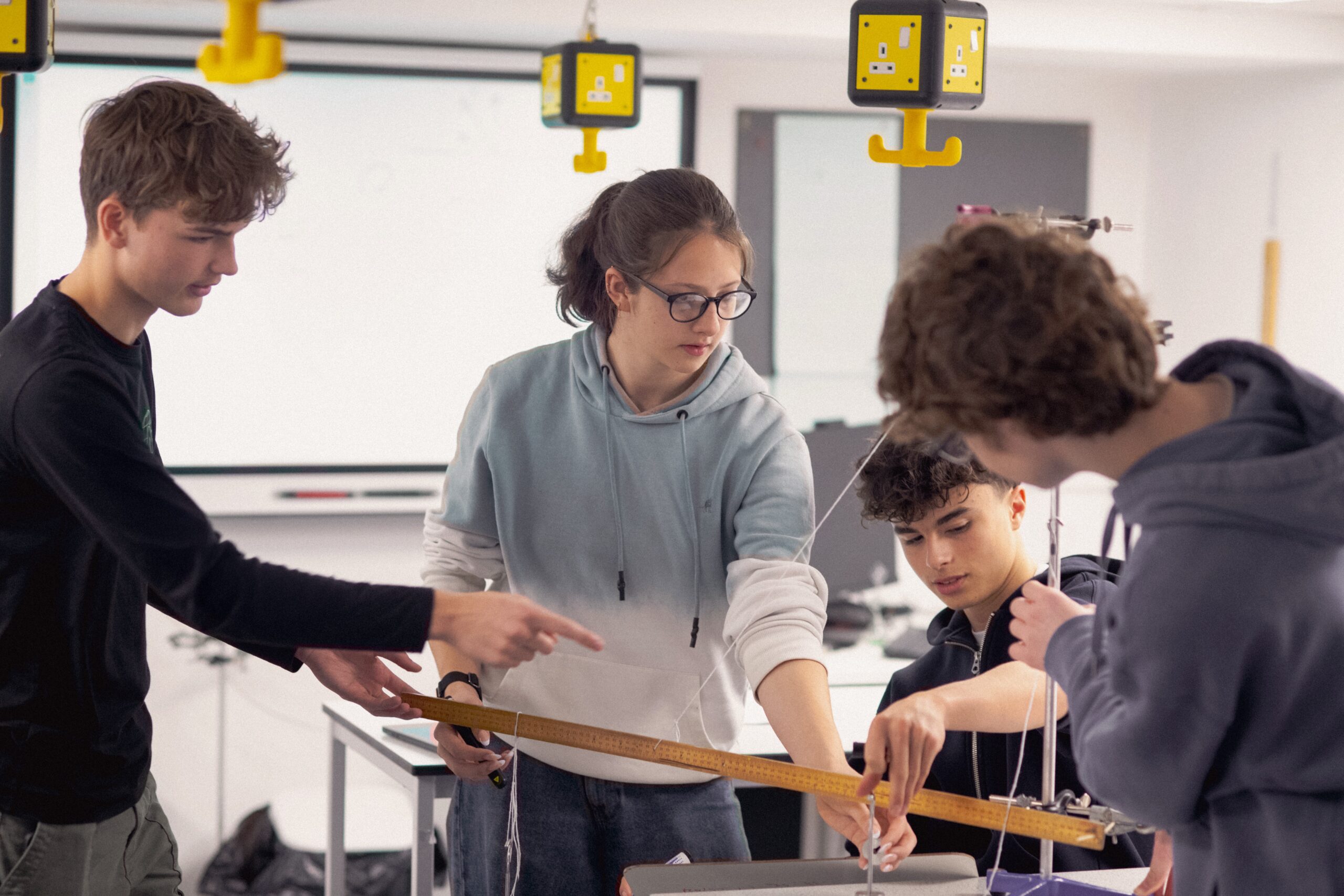
Physics is a practically taught subject through which students develop a deep understanding. They learn through logical thought and experimentation; the majority of lessons are in a dedicated specialist laboratory and Practical Skills are developed throughout the course, providing opportunities to apply knowledge and develop problem solving.
Qualifications
Examination board
A-level Physics
Eduquas
Assessment
A-level Phsyics is comprised of three components:
- Newtonian Physics
- Electricity and the Universe
- Light, Nuclei and options
Each component is assessed by a written examination. To gain a Practical Endorsement with their A-level, students will also complete Required Practical tasks.
Units of Study for Year 12
Students will work through both AS units and two modules from A2 units but will not sit any external examinations.
Units of Study for Year 13
Students will sit all 3 A-level components in their second year. They will build on the content of component 1 and 2 from year 12 and will also study for component 3.
Component 3 contains some optional content; students will choose one option from:
- Alternating Currents
- Medical Physics
- The Physics of Sports
- Energy and the Environment
Other Activities
Students take part in the British Olympiad, are supported in their preparation for Physics Aptitude Tests (PAT) and are encouraged to take part in team activities such as the Particle Physics Cascade and Engineering Education Scheme. More information can be found on our problem solving page.
For further details about our Physics curriculum, contact Malcolm: malcolmsimpson@exeterms.ac.uk